Amos French’s threat and recruitment of Don
Panic RoomAmos French’s threat and recruitment of Don Challenor begins as an offer of paid work and hardens into an ultimatum: Don must help trace money French says Jack Harkness stole, or French will approach Blake and Fran Revell directly. At Church Cove, with French’s formidable associate Zlenko close by, Don is offered money for information and given a week to produce it. The scene makes clear that the offer depends not only on what Don might discover, but on whom he can reach—and whom he wants to protect.
The encounter at Church Cove
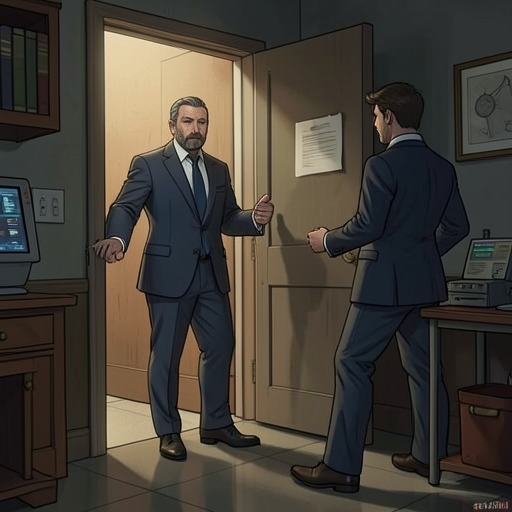
Don reaches Church Cove after a stiff climb from Poldhu Cove, his headache worsening and his thoughts returning to French’s unexpected telephone call. Its timing had made Don wonder whether French had been watching for him, though the text leaves that suspicion unconfirmed. In the car park, Don finds his MG beside a large black four-wheel drive. Its bearded driver, Zlenko, regards him with an unsettling stare; then the passenger gets out and introduces himself as Amos French.
French’s greeting is disarmingly familiar: he addresses Don by his first name and extends a hand. Don does not want to shake it, but does. The small gesture captures the imbalance of the meeting: Don’s guarded response does not prevent French from establishing the terms of contact. French comments on the sweetness of the air, a pleasant observation against the pressure Don already feels. The setting is open and coastal, but the encounter is not an escape from scrutiny; Don is meeting a man whose arrival and purpose make the car park feel like a place he has been cornered.
The money French wants
French asks whose name is on the deeds to the stylish property, connecting Don’s presence there to Harkness and to a possible hiding place. Don refuses to treat the question as French’s business. French answers that it is precisely his business: he is trying to find money he says Harkness stole from his employers, and the property may help him locate it. His accusation is presented as French’s claim, not as an established finding.
Don identifies Quintagler Industries as the likely employer. French qualifies the connection: he does not work for Quintagler directly. He also turns the questioning back on Don, pointing to Don’s LinkedIn profile and his departure from Mendez Chinnery. French implies that Don’s new freelance status leaves him vulnerable to financial pressure. The exchange shifts the encounter from an inquiry about Harkness’s property to an appraisal of Don himself: French has looked into his employment and believes that needing money could make him useful.
French acknowledges that he and Zlenko have already searched and found nothing. That failure explains why he is speaking to Don, but it also shows the limits of French’s existing access: he wants someone who can obtain information from people around Harkness. Don asks what French wants with him. French’s answer is mutual assistance, but the proposed bargain is unequal from the start: Don supplies information, while French sets the price, monitors progress, and decides what happens if the information does not arrive.
Access becomes leverage
French offers to pay more than Fran is paying Don for anything that could point toward Harkness’s money. The amount, he says, will depend on the information’s value and accuracy; how Don obtains it is Don’s concern, though French expects regular updates. The pitch gives Don an incentive while assigning him the risk and the investigative work. It also rests on French’s knowledge of Don’s connections: he knows that Don is on good terms with Blake and Fran and wants him to reach them on his behalf.
When Don says Blake knows nothing and stresses that Fran represents Mona Jackson rather than Harkness, he is not simply correcting French’s account; he is trying to keep both women outside the pressure of the investigation. French counters that Blake’s ignorance remains to be seen. He says Fran’s loyalties may be divided because she has recently met Harkness in circumstances that could appear covert. The meetings are offered as grounds for suspicion, not proof of disloyalty. By raising them, French makes Don’s personal knowledge of Fran another instrument in his approach.
The threat becomes explicit when French says that, if Don will not help, he will have to deal directly with Blake and Fran. He presents this as a consequence Don may wish to prevent if he has their interests at heart. The offer therefore has two faces: Don can earn money by charming, wheedling, or otherwise learning what French needs, and he can supposedly shield the women from French’s direct attention by cooperating. His effort to protect Blake is visible in his response, while the warning about Fran draws on their past relationship as well as their present connection.
The ultimatum and its unresolved answer
French makes the opportunity time-limited. He will allow Don a week while he follows other leads; after that, if Don has produced nothing, French threatens a more forceful approach. He does not specify exactly what that means, but Don understands the warning. The deadline converts a tempting offer into coercion: delay itself is made consequential, and Don is expected to keep French informed as he works.
The scene closes with French asking whether they are in business. Don recognizes that accepting a favour from his ex-wife has brought him into a problem he has little hope of solving and thinks he should have known better. That reaction registers the cost of the encounter before any answer is given. The evidence does not establish that Don accepts the bargain here; instead, it leaves him facing a choice in which refusal may expose Blake and Fran to French, while cooperation would make him an intermediary in French’s search for Harkness’s alleged stolen money. The recruitment’s decisive effect is thus to turn Don’s relationships into both an investigative resource and a point of vulnerability.